
Home Was Never a Place We Were Going to Stay Forever
One of the quieter advantages of a small town is how close everything actually is. In a metro society, groceries and daily essentials are usually sorted within the complex, but… In a metro society, groceries and daily essentials are usually sorted within the complex, but… In a metro society, groceries and daily essentials are usually sorted within the complex, but the moment you need something specific — nuts and bolts, a screwdriver, some odd bit of hardware — you discover it exists nowhere nearby. You either hunt down a specific market, open a delivery app, or order it online and wait, usually paying more for the privilege. In our hometown, that problem barely existed. Nearly everything we needed — hardware, groceries, school, even the hospital — sat within a ten-kilometre radius, and often much closer. When I started a kitchen garden, I sourced the seeds, pots and everything else locally, for a fraction of what the same things would have cost online. A good, budget-friendly playschool for our daughter turned out to be within walking distance. Cook and house help cost roughly half of what they would have in a metro city. And since only my wife was earning at the time, that lower cost of living genuinely mattered.
We had no idea back then that this chapter would turn out to be so much shorter than we expected. We’d come to the hometown assuming we’d stay — look after my parents, raise our daughter here, slowly shape our whole life around this city. So we planned accordingly, for something like ten to fifteen years: building an office, setting up a kitchen garden and compost system, enrolling our daughter in playschool, sketching out a small work-from-home business, building an ecosystem of cook, help and neighbours around us so we could look after my parents, our daughter, work and a future business all at once. It genuinely felt like the next chapter of our lives would be written here.
But life, it turns out, isn’t only written by our own planning. Within roughly a year of moving to the hometown, my mother passed away, and not long after, so did my father. My wife had already received an offer from a new company before that happened — with an understanding that she’d only need to be in office briefly before transitioning to permanent work-from-home — but she was still in her notice period when we lost both of them.
Once the necessary rituals were done, we were left with one real question: what now. Stay in the hometown, or go back south, where my wife’s job would be easier to continue and our daughter would have more options for her education? There’s also a simple truth underneath all of it — however good a hometown might be, certain things remain genuinely easier in a bigger city. Both my wife and I lean introverted by nature; too much time around too many people tends to bring on something close to social anxiety for both of us, which is partly why the relative anonymity of metro life has always sat more comfortably with us. And once my parents were gone, the emotional thread that had tied us most strongly to that city was gone with them.
There were a few other things that happened around that time too, which I’d rather not go into here — but they played their own part in that thread finally breaking. That’s a story for another time. Or maybe not at all.
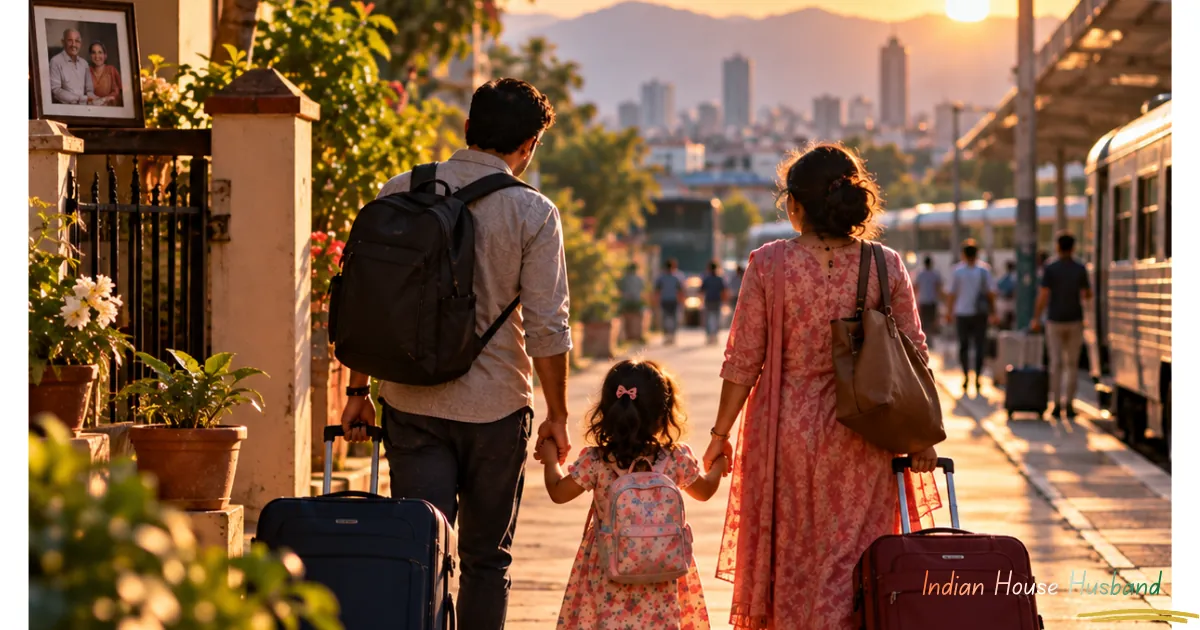
My father used to say, “Hoihi wahi jo Ram rachi raakha” — what will happen is only what has already been written. However much you plan, however many years you imagine living somewhere, once your place in that city is no longer meant to hold you, you eventually have to leave it. Our turn came too. The same hometown where we’d started planning for the next ten or fifteen years became the hometown we packed up and left, not very long after.
A lot happened in that stretch — enough that we weren’t even able to properly grieve my parents the way we probably should have. Life doesn’t always give you the time you need to mourn. Sometimes it just hands you the next decision, the next place, the next life to begin, whether you’re ready or not.
But maybe that’s the other side of it too. When you’re displaced from one place, perhaps something else has already been set aside for you somewhere else. We don’t know yet what’s ahead — what this new city will give us, how long we’ll stay, what will change along the way. For now, we’re simply trying to build a new home here, holding on to that uncertainty as something closer to hope than fear. Because maybe home was never really one fixed place to begin with. Maybe home is something we keep building, again and again, shaped by circumstance, together with the people we choose to build it with.
— Indian House Husband